The year was 2026, and inflation no longer felt like a temporary headline—it had become the stubborn background noise of daily American life. Food, rent, gasoline, and a dozen little necessities had all crept upward, making the dream of a comfortable retirement or a carefree adventure abroad seem increasingly distant. Lena, a 45‑year‑old freelance writer from Bisbee, Arizona, knew this all too well. Her charming small town boasted a low crime rate, negligible unemployment, and a cost of living hovering around $2,043 a month. That was better than the national average, but it still meant her savings were draining faster than she liked. Late one evening, as she scrolled through forums for expats and retirees, a thought crystallized: what if her dollars could work harder somewhere else? What if she could trade the desert heat for a life where $1,500 a month didn’t just cover the bare essentials—it bought comfort, discovery, and maybe even a few luxuries?
The numbers she found startled her. Countries like the Philippines, Vietnam, and Brazil promised full, vibrant lives for half of what she was spending. Others, like Spain and South Africa, offered a blend of Old World charm and modern convenience without draining her bank account. All of them shared one irresistible trait: a monthly budget of under $1,500 could open the door to a new existence. This is the story of the seven countries that captured Lena’s imagination—and continue to lure thousands of Americans in search of affordability, adventure, and a place where the word “home” can be redefined.
Spain surged to the top of Lena’s list before she even finished her first cup of coffee. The thought of waking up to cobblestone streets, sun‑drenched plazas, and the distant strum of a flamenco guitar felt almost too romantic to be cheap. Yet the numbers were soberingly real. In cities like Valencia or Seville, a single person could rent a bright apartment, feast on tapas and Rioja, and still keep monthly expenses comfortably beneath the $1,500 threshold. Spain’s magic wasn’t just financial, though. It was the fiestas that erupted in every village, the architectural wonders that spanned Gothic cathedrals to Gaudí’s whimsy, and a climate that seemed to erase the very concept of a bad day. And then there was the passport—one of the strongest on the planet, granting visa‑free entry to 194 countries. For someone with Lena’s wandering spirit, that was a golden ticket. She could already picture herself adopting the local rhythm: a siesta after lunch, a late‑night paseo, and weekends devoted to cheering herself hoarse at a Real Madrid or FC Barcelona match.
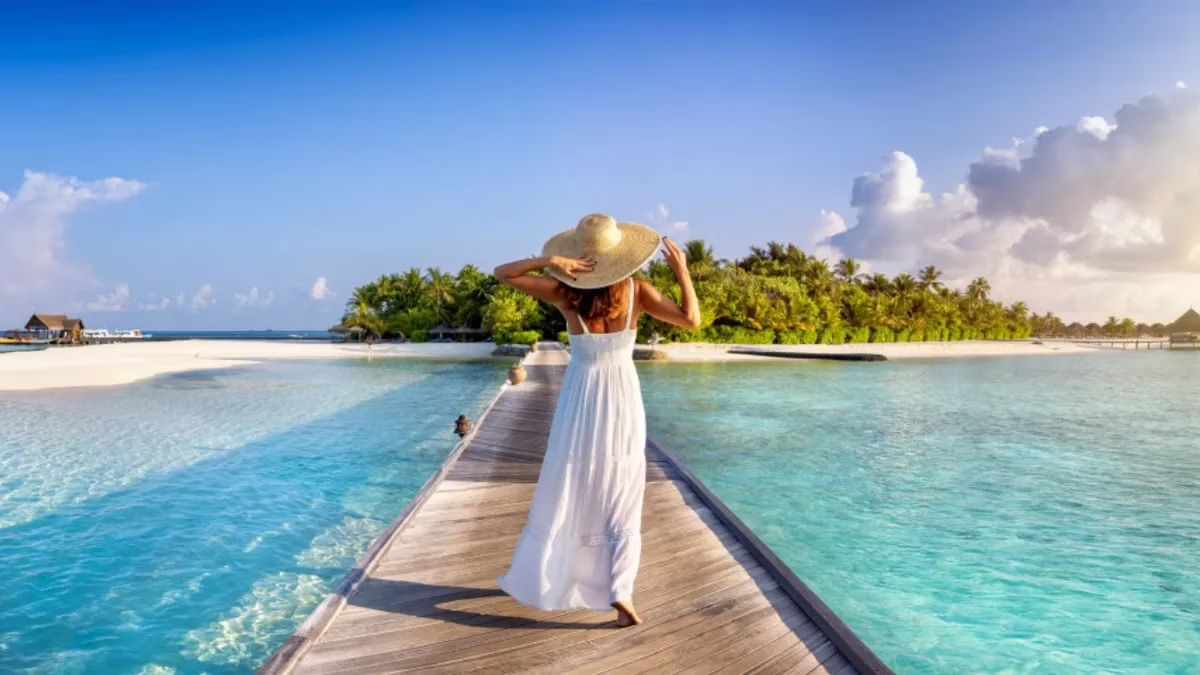
Nearly five thousand miles east, the Maldives made a very different kind of promise. Lena had always dismissed the archipelago as a playground for the ultra‑rich, but the data proved her wrong. A single person could live comfortably on about $1,263 a month, and that figure included a simple apartment on a local island—not a $1,000‑a‑night overwater villa, but a genuine home surrounded by the same impossible turquoise water. The Maldives offered not just affordability, but an immersion into a slow, sun‑bleached rhythm. Days would be measured by the tide, by the color of the coral just offshore, by the sting of salt on her skin. The warm, tight‑knit island communities welcomed outsiders with a quiet grace, and the booming tourism industry meant English was widely understood, easing the transition for an American. Lena imagined learning to free‑dive, to cook mas huni for breakfast, and to find contentment in the simplicity of a life that required so little yet gave so much back.
From the Indian Ocean, Lena’s attention swung to the southern tip of Africa. South Africa beckoned with a grandeur that was equal parts wild and sophisticated. In cities like Johannesburg and Pretoria, a foreigner could rent a spacious flat, access excellent private healthcare, and still keep total monthly spending well below $1,500—a figure that, back in Arizona, barely covered her bills. But the real draw was the sheer diversity compressed into one nation. One weekend could mean hiking in the Drakensberg Mountains, the next could be spent sipping world‑class wine in Stellenbosch, and a third might lead to the haunting beauty of the Cape of Good Hope. South African hospitality was legendary; strangers became friends over a shared braai, and the blend of cultures produced a music and art scene that vibrated with life. Lena read about expats who had arrived intending to stay a year and were still there a decade later, captivated by the country’s ability to be both an adventure and a sanctuary.
Then came Brazil, and with it a rush of sensuality and rhythm that made Lena’s heart beat faster. The phrase “less than $800 a month” kept echoing in her mind. For that sum, she could settle in a coastal city like Fortaleza, where the beaches seemed to stretch into eternity and the scent of grilled fish and dendê oil drifted through the streets. Brazil wasn’t just a budget move; it was an embrace of life lived loudly. The Amazon Rainforest, still revealing its age‑old secrets, promised frontier explorations. The warm, mixed‑heritage soul of the people meant a newcomer could soon find herself swept up in a roda de samba or invited to a family churrasco. Feijoada—the slow‑cooked black‑bean stew—would become a Saturday ritual, and the national obsession with football would become her own. Lena smiled, imagining herself in a yellow jersey, shouting at a television alongside 200 million new compatriots.
Bulgaria crept onto her radar more quietly, but its pull grew with every article she read. Nestled in the heart of the Balkans, the country was an underrated gem where ancient history and untamed nature collided at prices that felt almost anachronistic. Renting a one‑bedroom in Plovdiv, a city built in layers across seven hills, cost a fraction of what she paid in Bisbee. She could wander the cobbled streets of the Old Town in the morning, attend a concert in a Roman theatre that had withstood two thousand winters in the evening, and still have money left for a hearty meal of shopska salad and rakia. The Balkan Mountains offered cool retreats in summer, while the Black Sea coast provided sandy beaches that rivaled the Mediterranean’s, minus the crowds and the price tag. For Lena, Bulgaria represented the quiet confidence of a place that didn’t need to shout to be heard—and where a modest budget bought a lifestyle steeped in depth and authenticity.
The Philippines was the entry that finally made Lena close her laptop and exhale, because it felt almost too good to be true. Over 7,000 islands, thousands of miles of white‑sand beaches, and a cost of living that could slide under $1,000 a month if she lived modestly. English was an official language, a legacy of American influence, which meant she could chat with locals from day one. The third‑largest English‑speaking country on Earth was also a nation of irrepressible joy: karaoke (videoke, as they called it) was practically a civic duty, festivals painted the calendar in explosions of color, and the hospitality was so intense it had its own word—“mabuhay,” a welcome that was also a celebration of life. Lena read about the Spanish‑era fortress of Intramuros, the chocolate hills of Bohol, and the challenge of eating balut with salt and spicy vinegar. She imagined herself learning to scuba dive in Cebu or simply swinging in a hammock on Palawan, days melting into weeks. For an American seeking a tropical home where her dollars would stretch and her spirit could expand, the Philippines seemed to whisper a perpetual invitation.
Lastly, Vietnam stole its way into her plans with quiet, astonishing figures. Around $600 a month was enough for a comfortable life in cities like Da Nang or Hoi An—places where French colonial architecture dozed beside Buddhist pagodas, and the smell of phở broth and fresh herbs rose from street stalls before dawn. The contrast with Vietnam’s wartime past could not have been more stark; the country had transformed its pain into a forward‑leaning energy that pulled in entrepreneurs, teachers, and retirees alike. Lena envisioned mornings spent riding a bicycle through rice paddies, afternoons devoted to perfecting her Vietnamese coffee recipe, and evenings eating bánh mì with locals who, despite a history of unimaginable hardship, greeted foreigners with remarkable warmth. The sense of community was palpable, the laid‑back rhythm inexorable, and the financial freedom real. Here, on a budget that would barely cover groceries back home, she could not only survive—she could flourish.
As Lena closed her research and started drafting a list of visa requirements, she realized the thread that connected these seven countries was not merely their affordability, but their promise of a life unmuted. In Spain, she could dance. In the Maldives, she could float. In South Africa, she could roam. In Brazil, she could celebrate. In Bulgaria, she could reflect. In the Philippines, she could connect. In Vietnam, she could heal. The $1,500‑a‑month threshold was not a limitation; it was a doorway into a world where happiness wasn’t measured by square footage, but by the depth of the experiences that filled each day. Somewhere out there, in a cobbled alley or on a palm‑fringed shore, a different version of herself was already waiting.
Loading comments...